
- Home
- Ways of payment
- Coins and banknotes in circulation


Ways of payment
Coins and banknotes in circulation
Everyday transactions in New Caledonia, French Polynesia and Wallis and Futuna are carried out in CFP francs (F CPF). Coins and banknotes are issued by the branches of the Institut d’émission d’Outre-Mer (IEOM).
Which coins and banknotes are used in the Pacific ?
Coins
On 1er september 2021 IEOM introduced new CFP franc coins in New Caledonia, French Polynesia and Wallis and Futuna. This modernisation followed the renewal of the banknote series in 2014.
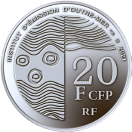
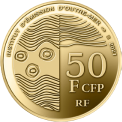
There are six coin denominations in circulation : 5, 10, 20, 50, 100, and 200 CFP francs. Each coin features a distinctive design: :
- Reverse side: The face value and year of minting (millésime), along with the inscriptions ‘Institut d’Émission d’Outre-Mer’ and ‘RF’ (for République française) ;
- Obverse side: Displays a central motif and smaller decorative elements around the edge or in a band representing the richness and diversity of the three territories.
Exchanging old coins
Since 1 December 2022, only the new coins are accepted in shops and banks, marking the end of the dual circulation period. If you still have old coins, you can exchange them at your local IEOM office. Information on the exchange process is available on the website of your local IEOM office.
Please note that collecting old coins is an important environmental issue in our territories. We encourage you to recycle them rather than leaving them in the environment.










Banknotes
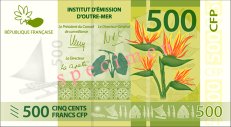
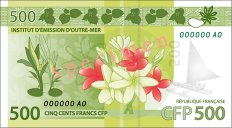
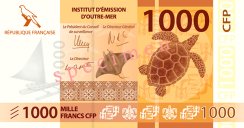
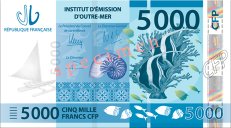
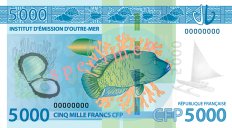
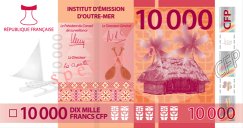
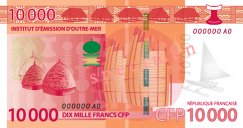
Banknotes in the Pacific region are issued in four denominations : 500, 1 000, 5 000 and 10 000 CFP francs. Each note has a ‘New Caledonian’ side and a ‘Polynesian’ side, and both sides feature elements representing Wallis and Futuna. All banknotes are secure and have distinct colours.
To improve accessibility, especially for blind and visually impaired individuals, each note is a different size. Starting with the 500 CFP franc note, the length increases by 6 mm for each higher denomination..

How to exchange a damaged banknote ?
For the smooth functioning of our monetary system, it is important that banknotes are in good condition for your daily transactions. Damaged banknotes can be exchanged at your local IEOM agency. The exchange process depends on the condition of the note :
- If the banknote is genuine and more than 50% of its original surface remains, you will receive an immediate replacement with a new note.
- For severely damaged banknotes (e.g. burn marks, large tears), a detailed assessment will be carried out. If the note is deemed eligible for reimbursement, IEOM will contact you to arrange the refund at the agency counter.
For more information on the conditions for exchanging damaged banknotes, visit the ‘Banknote Exchange’ section on your local IEOM agency’s website.
I indicate my place of residence.
What are the rules for cash payments ?
The regulations governing the use of banknotes and coins in F CFP apply in New Caledonia, French Polynesia and Wallis and Futuna.
Acceptance of cash by merchants
Merchants are required by law to accept CFP franc banknotes and coins as legal tender; otherwise, they may face a fine. However, they may ask you to provide exact change, as they are not required to give change.
Important : Banknotes and coins must be in good condition to be accepted.
Cash payment limits
The limits on cash payments are determined based on the payer’s status and tax residency. These limits are set out in Articles L. 112-6 and D. 112-3 of the French Monetary and Financial Code and apply to the French overseas territories in the Pacific :
- 119 330 F CFP pour les transactions entre professionnels ou entre un professionnel et un particulier lorsque le débiteur est fiscalement domicilié en France ;
The current thresholds are as follows :
- 1 193 315 F CFP for transactions between professionals, or between a professional and an individual when the debtor is a French tax resident ;
- 1 789 975 F CFP for non-French tax residents acting for non-professional purposes and paying someone who is not subject to anti-money laundering and counter-terrorism financing (AML/CTF) obligations. ;
- 179 000 F CFP when the debtor is a non-resident acting outside a professional context but paying someone who is subject to AML/CTF obligations ;
- 119 300 F CFP for the monthly payment of wages or salaries. However, signing a receipt is recommended.
Exceptions : these limits do not apply to :
- Individuals without a bank account ;
- Persons under a banking ban ;
- Transactions between private individuals for non-professional purposes. Written proof of payment is required for transactions between individuals exceeding 179,000 F CFP.
Important: Cash payments are not permitted for the purchase of metals by a professional from an individual or another professional. Payment must be made by crossed cheque or bank transfer to an account held in the seller’s name Article L. 112-6, paragraph 3).
 Please note:
Rounding rule
What does the law say about counterfeiting ?
The fight against the counterfeiting of banknotes and coins is strictly regulated by law.
Counterfeiting or falsifying currency is a criminal offence and is subject to legal penalties. Therefore, it is strictly prohibited to :
- Counterfeit, falsify, or even imitate currency ;
- Circulate banknotes known to be counterfeit ;
- Reproduce banknotes identically. This is considered intent to produce counterfeit currency and constitutes an offence.
Important
Using euro banknote designs or graphics for illustrative purposes is permitted, provided it does not constitute counterfeiting or unlawful imitation.
This use is strictly regulated to avoid any confusion with real banknotes. Therefore, any reproduction project must be submitted in advance for authorisation by IEOM.
The impact of these rules on everyday life
Anyone who receives suspicious coins or banknotes must present them to the IEOM for verification :
- If the notes or coins are genuine, they will be exchanged free of charge ;
- If the notes or coins are counterfeit, a receipt will be issued
- For professionals, this receipt from IEOM can be used as proof of loss for accounting and tax deduction purposes.
Merchants are entitled to refuse banknotes that are damaged, appear suspicious or are in such poor condition that their authenticity cannot be verified.
Criminal penalties for counterfeiting or forgery
Penalties for counterfeiting or falsifying banknotes or coins are severe. The French Penal Code provides specific sanctions for each offence, including fines and/or prison sentences: :
- Article 442-1 of the Penal Code : ‘Counterfeiting or falsifying coins or banknotes that are legal tender in France, or issued by authorised foreign or international institutions, is punishable by thirty years of criminal imprisonment and a fine of 53,699,285 F CFP. ’
- Article 442-3 of the Penal Code : ‘Counterfeiting or falsifying French or foreign coins or banknotes that are no longer legal tender or authorised for circulation is punishable by five years’ imprisonment and a fine of 8,949,880 F CFP. ’ .
- Article 442-6 of the Penal Code : ‘The manufacture, sale or distribution of any objects, printed matter or templates that resemble the monetary signs referred to in Article 442-1 in a way that may facilitate their acceptance as genuine currency is punishable by one year’s imprisonment and a fine of 1,789,975 F CFP’ ;
- Article 442-7 of the Penal Code : ‘Anyone who, having received counterfeit or falsified monetary signs as referred to in Article 442-1 in good faith, later redistributes them after discovering the forgery, shall be liable to a fine of 894,990 F CFP.’
If you wish to speak to someone or send an e-mail, contact the IEOM office in your area, which will provide you with information :
I find my IEOM agency
Choose


